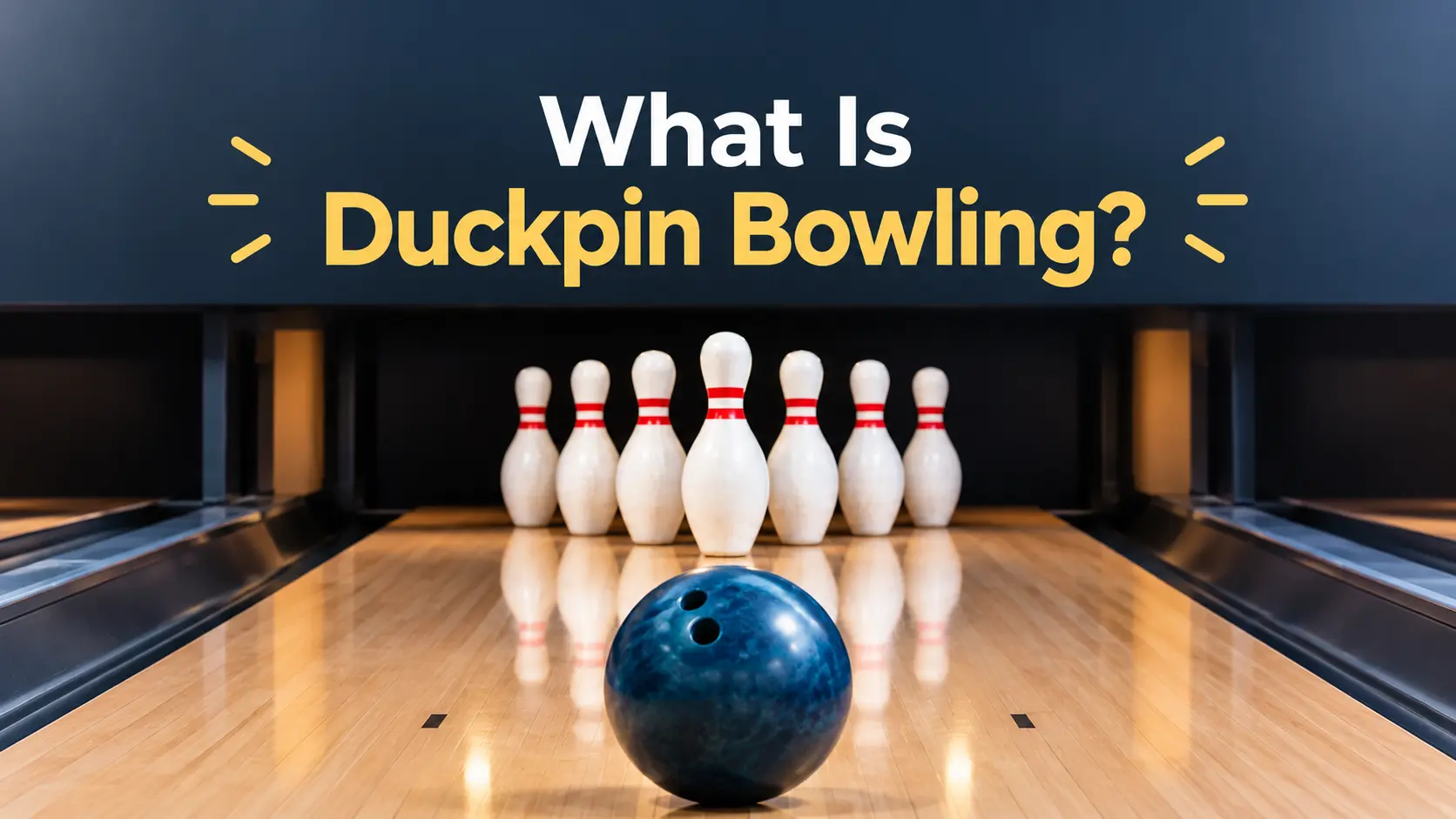
Duckpin bowling is a version of bowling played with a ball small enough to hold in one palm, with no finger holes, rolled at ten short pins. You get three rolls per frame instead of two. The ball weighs no more than 3 lb 12 oz and the pins stand 9½ inches tall, a little under two-thirds the height of the pins in regular ten-pin bowling.
That size difference is the whole sport. A ten-pin ball does most of the work for you once you have picked one heavy enough. A duckpin ball does not, which is why the game gives you an extra roll, and why nobody has ever bowled a perfect game in sanctioned play.
The ball fits in your palm and has no holes
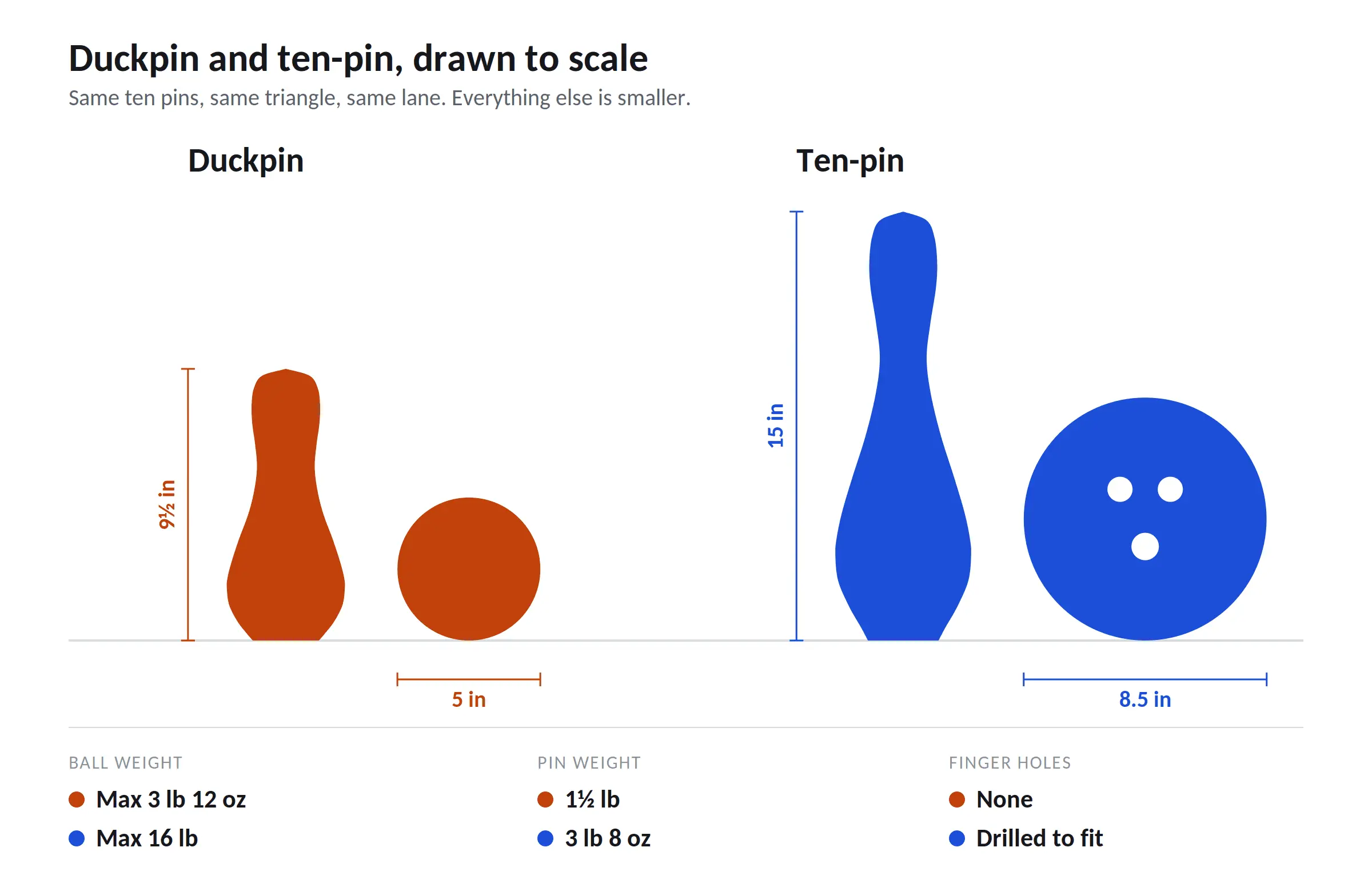
A duckpin ball measures between 4¾ and 5 inches across and weighs a maximum of 3 lb 12 oz, according to the National Duckpin Youth Association. There are no finger holes. You hold it the way you would hold a grapefruit and roll it underhand or overhand, whichever feels right.
Compare that to a ten-pin ball, which runs 8.5 to 8.595 inches in diameter and up to 16 pounds, with finger and thumb holes drilled to fit an individual bowler. A ten-pin ball has to be selected for weight and grip. A duckpin ball does not, because every ball on the rack is identical and light enough for almost anyone to roll.
The practical consequence is that there is no equipment step before you start playing. Nobody is testing thumb holes or hunting down an eight-pound ball for the youngest person in the group.
The pins are short, squat and light
Duckpins are 9½ inches tall, 4⅛ inches across at the widest point, and weigh 1½ pounds each. Ten-pin pins are 15 inches tall, 4.75 inches wide, and weigh 3 lb 8 oz. Same ten pins, same triangle, roughly half the mass.
Light pins struck by a light ball behave differently from heavy pins struck by a heavy ball. They scatter rather than topple into one another, which is where the sport got its name and why a clean strike is uncommon.
Three rolls, not two
Every frame in duckpin gives you three rolls at the pins. Ten-pin gives you two. The extra roll exists because clearing all ten with a ball under four pounds is genuinely difficult, and a two-roll game would produce scores low enough to stop being fun.
The game still runs ten frames. The order of play, the triangle of pins and the lane itself are the same as ten-pin. Only the ball, the pins and the third roll change.
How duckpin scoring works
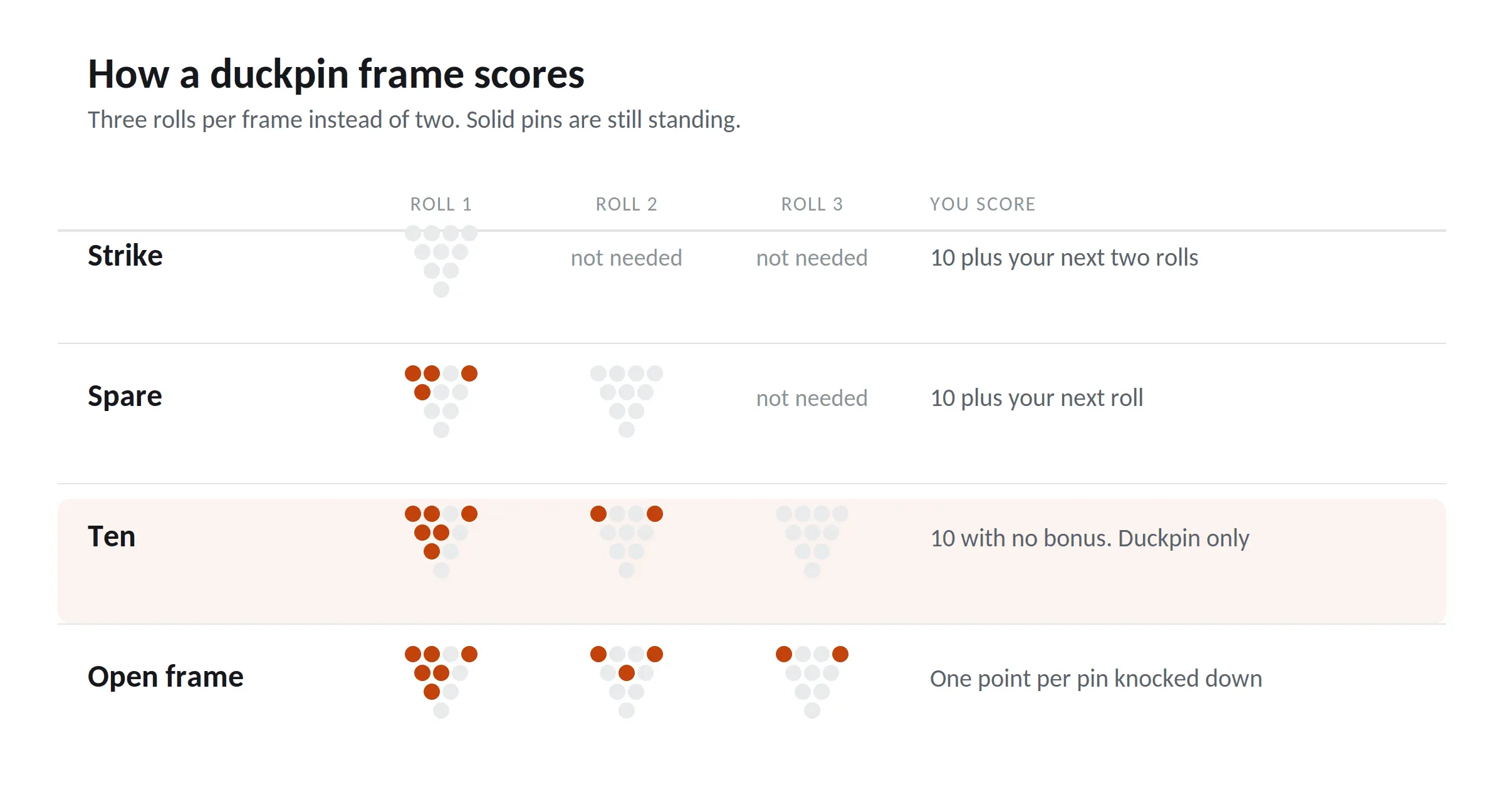
Duckpin scoring follows ten-pin scoring almost exactly, with one addition for the third roll.
- Knock down all ten pins on the first roll and you have a strike, worth 10 plus whatever you score on your next two rolls.
- Knock down all ten across two rolls and you have a spare, worth 10 plus your next roll.
- Knock down all ten using all three rolls and you score 10 with no bonus. This is the duckpin-only outcome, sometimes called a ten.
- Leave any pin standing after three rolls and you score one point per pin knocked down.
The absence of a bonus on that third roll is what keeps duckpin scores lower than ten-pin scores. A good duckpin game and a good ten-pin game do not look alike on paper. Scoring in the 100s is a solid duckpin game, so do not judge it against the ten-pin numbers you may be used to.
Duckpin vs ten-pin vs candlepin
Three small-ball bowling variants get confused with one another. Here is where each actually sits.
| Duckpin | Ten-pin | Candlepin | |
|---|---|---|---|
| Ball diameter | 4¾ to 5 in | 8.5 to 8.595 in | 4½ in |
| Ball weight | Max 3 lb 12 oz | Max 16 lb | Max 2 lb 7 oz |
| Finger holes | None | Yes, drilled to fit | None |
| Pin height | 9½ in | 15 in | 15¾ in |
| Pin weight | 1½ lb | 3 lb 8 oz | Max 2 lb 8 oz |
| Pin shape | Short and squat | Tapered | Thin cylinder |
| Rolls per frame | 3 | 2 | 3 |
| Fallen pins cleared between rolls | Yes | Yes | No |
Table: duckpin sits between ten-pin and candlepin on ball size, and below both on pin height. Specifications from the National Duckpin Youth Association, Britannica and Wikipedia.
The quickest way to tell duckpin from candlepin is the pin shape. Duckpin pins are short and fat. Candlepin pins are tall and thin, like a candle. Candlepin also leaves fallen pins on the lane between rolls, which duckpin does not.
Nobody has bowled a perfect game since records began
A perfect duckpin game is 300, the same as ten-pin. It has never been rolled in sanctioned play. The closest anyone has come is 279, set by Pete Signore Jr. in 1992, and that record still stands more than thirty years later.
A 300 is the maximum in ten-pin and candlepin as well, but duckpin is the one where it has never been reached under sanctioned conditions. Keep that in mind before comparing a duckpin score against your ten-pin average, because the two numbers do not measure the same thing.
Where duckpin came from and why it is called that
The popular account credits Baltimore Orioles players John McGraw and Wilbert Robinson, who ran a bowling alley in Baltimore around 1900. Britannica dates the game’s introduction to 1900 at their establishment. The name is attributed to Robinson, who reportedly thought the small white pins flying around after a hit looked like ducks taking off.
One honest caveat on that story: Wikipedia notes research indicating the game was already being played in New England cities including Boston, New Haven and Lowell as early as 1894, which predates the Baltimore version of events. Baltimore is where duckpin took hold and became a regional institution, but it may not be where it started.
The National Duckpin Bowling Congress, the sport’s governing body, was founded in 1927 and still sets the equipment specifications quoted throughout this page.
Duckpin lanes are rare outside Maryland and New England. Kartopia in Van Nuys has two duckpin lanes, alongside indoor go-kart racing, an arcade and a soft play area for younger children. See current rates on the walk-in pricing page.
Two lanes means duckpin works best for small groups and as one stop in a longer visit rather than as an afternoon of league-style bowling. Planning something bigger? Check availability with us first or look at the party and event packages.
Frequently asked questions
1- Is duckpin bowling harder than regular bowling?
Duckpin bowling is harder. The sport gives players three rolls per frame rather than two precisely because clearing ten pins with a ball under 3 lb 12 oz is difficult. The highest sanctioned duckpin game on record is 279, set in 1992, and no one has rolled a perfect 300 in sanctioned duckpin play.
2- Do you need bowling shoes for duckpin bowling?
Footwear rules depend on the venue rather than on the sport. Traditional duckpin houses that run sanctioned leagues generally require bowling shoes, while many entertainment centres with a couple of lanes let guests play in their own shoes. Check with the venue before you go.
3- Can young children play duckpin bowling?
Young children can usually manage duckpin more easily than ten-pin. A duckpin ball weighs a maximum of 3 lb 12 oz and has no finger holes, so there is no grip to fit and no minimum weight a child has to handle. Every ball on the rack is the same size.
4- How do you get a strike in duckpin bowling?
Accuracy matters more than power in duckpin. A light ball carries little momentum through the rack, so hitting the pocket beside the head pin at the right angle does more than rolling hard. Strikes are uncommon even among experienced players, which is why the third roll exists.
5- How long does a game of duckpin bowling take?
A duckpin game runs ten frames, the same as ten-pin, but with up to three rolls per frame instead of two, so a full game involves roughly 50 percent more deliveries than a ten-pin game of the same length. Most groups play more than one game per visit.
6- Does duckpin work for a group with mixed ages and skill levels?
Duckpin suits mixed groups well. Because every ball is identical and light, nobody has to be matched to equipment before playing, and the three-roll frame keeps scores closer together than ten-pin does. Adults and children use exactly the same ball.
If you are weighing up where to take a group, our guide to arcades in Los Angeles covers the four formats worth knowing about and what each one costs.